Your Preschooler Isn’t Failing at Yoga
What two minutes of chaos teaches them (and you)
You roll out the mat. You cue the music. You say, “Okay, let’s do yoga!” — and your three-year-old immediately turns into a tornado. They roll across the mat. They announce they’re a dinosaur. They ask for a snack. Within two minutes, they’re gone.
You sit there wondering: Am I doing this wrong? Is my kid just not a yoga kid?
Here’s what I want you to know: that moment — the chaos, the wiggling, the very short attention span — is not failure. It’s developmental science doing exactly what it’s supposed to do.
What Research Tells Us About How Preschoolers Actually Learn
Before we talk about yoga, it helps to understand what’s happening inside your child’s brain and body. The preschool years (ages 3–5) are one of the most explosive periods of human development. Here are ten of the most important research findings that shape how we should approach yoga — and any learning — with this age group:
- Attention spans are developmentally short — and that’s normal. Research consistently shows that children ages 3–5 can sustain focused attention for roughly 2–5 minutes on a single task. This is not a deficit. It’s exactly where their brains should be. Expecting longer focus sets both parent and child up for frustration.
- Movement is how preschoolers think. Studies in embodied cognition show that young children process and store information through physical movement, not passive listening. When your child moves their body into a pose, they are actively encoding that learning — far more effectively than if they simply watched you do it.
- The brain is building its stress-response system right now. Neurological research confirms that the prefrontal cortex — the area governing emotional regulation, impulse control, and attention — is under major construction during the preschool years. Practices like slow breathing and gentle movement directly support healthy development of this system.
- Co-regulation precedes self-regulation. Children at this age cannot regulate their own nervous systems independently. They rely on calm, regulated adults to co-regulate with them. A parent’s steady breath and relaxed body literally signals safety to a child’s nervous system, helping them calm.
- Play is the primary learning vehicle. Decades of developmental research, including landmark studies from Dr. Stuart Brown and colleagues, confirm that for ages 3–5, play is not a break from learning — it is learning. Yoga framed as play — not exercise — is the most developmentally appropriate delivery method.
- Language and imagination explode at this stage. Between ages 3 and 5, children’s vocabularies grow by roughly 5–9 new words per day. They are also deeply engaged in imaginative, symbolic thinking. Yoga poses named after animals and nature (cat, tree, cobra) map perfectly onto this developmental window.
- Proprioceptive and vestibular input are essential. Research in sensory processing shows that preschoolers have a neurological need for heavy input — pushing, pulling, balancing, and feeling their bodies in space. This is why they climb everything. Many yoga poses fulfill this need in a structured, calming way.
- Short, repeated exposures build lasting skills. Cognitive science research on young learners shows that brief, consistent practice — even just 3–5 minutes daily — builds neural pathways more effectively than longer, infrequent sessions. Five minutes of yoga every day outperforms 30 minutes once a week.
- Social mirroring is a powerful teacher. Preschoolers are wired to watch and imitate the significant adults in their lives. Research on mirror neurons and social learning confirms that children learn more from what caregivers do than from what they say. Your calm, grounded body is the curriculum.
- Stress in the home environment directly affects children’s nervous system development. Research in early childhood adversity and epigenetics shows that a child’s stress-response system is profoundly shaped by the emotional climate of their home. A parent who practices mindfulness — even imperfectly — creates a calmer baseline for their child’s nervous system.
The One Thing Most Parents Don’t Know (But Changes Everything)
Here’s what I’ve seen in years of teaching children’s yoga: parents spend a lot of energy trying to get their child to do the poses correctly. And I understand why — it feels like that’s the point.
But finding #9 above points to something much more powerful: your calm body teaches more than any instruction you could give.
When you sit on the mat and breathe slowly, you’re not just doing yoga. You’re giving your child’s nervous system a live demonstration of what regulated feels like. Their mirror neurons are watching. Their stress-response system is taking notes. They may be pretending to be a T-Rex instead of doing Tree Pose, but their body is absorbing your calm like a sponge.
This means you can stop performing yoga for your child. You can just do it near them.
That’s a very different — and much more sustainable — kind of home practice.
What a 5-Minute Home Yoga Practice Looks Like at This Age
Forget the sequence. Forget holding poses for five breaths. Here’s what’s developmentally appropriate for a 3–5 year old:
• It lasts 3–8 minutes, not 20. That’s not a short practice. That’s the right practice.
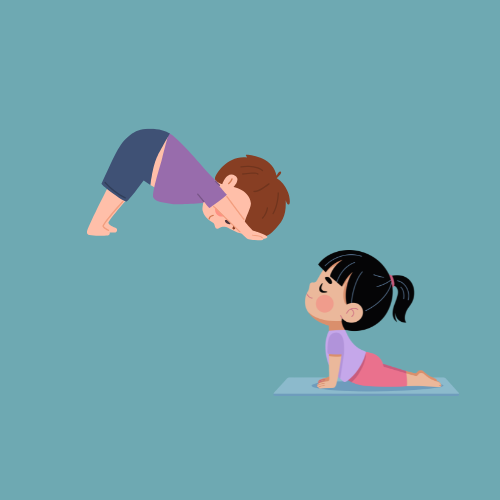
• It involves animals. Cat, cow, cobra, frog, downward dog. The imagination is the bridge into the body at this age.
• It ends with something still. Even 60 seconds of resting on their back with a hand on their belly is genuine mindfulness practice for a preschooler.
• You are on your mat too. Not coaching from the side. Not correcting. Breathing.
• Chaos is welcome. If they roll around and make sound effects, they’re still in the experience. Their body is still near yours. The co-regulation is still happening.
Want to Go Deeper?
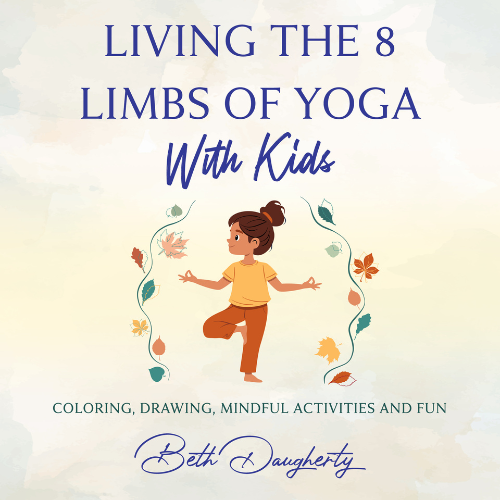
If this resonated with you — if you’re curious what a full, developmentally-grounded children’s yoga practice looks like across all the preschool milestones — I’ve written extensively on exactly this in my book.
It walks parents and educators through the eight-limb yoga system adapted for young children, with age-appropriate poses, language, breathing practices, and the child development research behind each one. It’s designed so that you don’t have to be a yoga teacher to use it — just a grown-up willing to sit on a mat and breathe.
Your child isn’t failing at yoga. They’re waiting for you to show them what calm looks like.
Download Living the 8 Limbs of Yoga with Kids
Or if you like paperbacks, it is available on Amazon with all the coloring pages and activities